
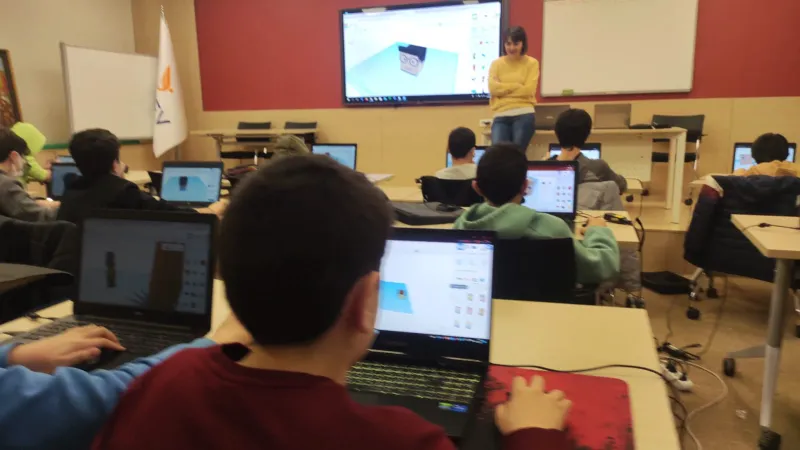
In our 8-week Tinkercad (3D Design) lessons, we aim to develop our students' three-dimensional modelling and thinking skills and to give them a solid foundation in graphics and design from an early age.
In our 8-week Tinkercad (3D Design) lessons, we aim to develop our students' three-dimensional modelling and thinking skills and to give them a solid foundation in graphics and design from an early age.
With the design knowledge they gain in this course, our students can design and print countless objects they imagine, such as toys, game characters, key rings or chess pieces.
Our lessons are held online, two lesson periods per week.
In our Online & Face-to-Face classes, lesson times are arranged according to a timetable that suits the students' schedules.
INFORMATION VIA WHATSAPP: 0538 985 74 87 (between 11:00 and 19:00)
3D DESIGN AND ITS IMPORTANCE IN CHILDREN'S EDUCATION
3D modelling and printing, an indispensable part of maker education, can be used to create a prototype of our own products before manufacturing them at real size and in real materials, or to produce simple, handy items for everyday life such as small mechanical tools, pen holders, toys and ornaments.
You can think of what we call prototyping as the scale models architects build before putting their projects into practice. With today's higher-quality prints, 3D printing is now used for this purpose too. Among individual users abroad, there are even enthusiasts who have taken things so far as to print their own miniature castle. You can take a look here:
Did you know that IKEA, one of the most popular home furnishing and furniture brands, first 3D prints its spoons, tables and chairs to see them? And what about NASA using a 3D printer in space? As you might guess, since the satellites sent into space are mechanical devices, they sometimes need repairs and new parts depending on the conditions they face. NASA's solution was to send a 3D printer into space, sparing itself the heavy financial burden of manufacturing new parts and launching them into space.
Its importance in children's education
Up to a certain age, children cannot construct abstract concepts in their minds, so these concepts need to be presented to them in as concrete a way as possible. When explaining a speed problem, we try to illustrate it with real-life examples, body language, or little role-play games using the materials at hand – for example, one student playing the Sun while their classmates play the planets and take turns orbiting around them. When today's technology is used in lessons to support such activities, learning becomes faster and easier. If we print a 3D model of the solar system, students will not only see the shapes of the planets more easily but will also be able to touch a tangible object.
This is just one small example of how 3D design and printing can be used. Of course, its uses can be extended much further with a little imagination. Consider the age groups of primary and middle school students: their imagination has not yet been held back and their capacity to learn is remarkably high. Tell them there is an environment where they can use their talents and build the objects and devices they dream up – and show them the way.
3D Design and productivity
Being able to hold the products they imagined and designed in their hands as real objects was a wonderful experience for them. It is an effective way of instilling, in a balanced way, the confidence that "I can do it too". The child sees their discovery come to life and can also see where they went wrong through a live, hands-on example.
Looking at the traditional education system, we can see that students' imagination is restricted in many areas. Their boundless and beautiful imaginative worlds can be held back with words like "you can't do that, it's impossible". Yet instead of teaching students what is impossible, guiding them to look for solutions may enable them to solve even the problems that current technology cannot yet overcome. Let us not restrict their imagination, so that we never lose hope in our future generations.
3D design and printing, which gives children a different perspective, a sense of reality and much more, is one of the most important technologies that can – and should – be integrated into education. By contributing to students' cognitive, affective and kinaesthetic development, it enables them to grasp the materials they plan to produce, or any topic linked to it in class, in a more concrete and lasting way.
The bottom line is this: we achieve real results when we place technology in education in the right place and at the right time. To do so, we must always stay open to innovation and different perspectives, and act by asking ourselves "How can it be used?" and "Where exactly is it really needed?"