
Robotics and coding scholarships for a thousand students during the pandemic. TACEV General Education Coordinator İsmail Bakal: "We want to raise a generation of digital producers, not digital consumers." As part of its "Young Explorers at Work" project, TACEV Education Foundation is offering students free online coding training during the pandemic...
TACEV General Education Coordinator İsmail Bakal: "We want to raise a generation of digital producers, not digital consumers"
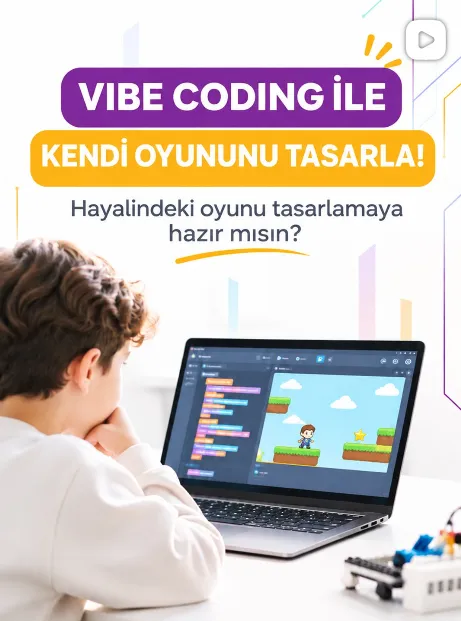
ISTANBUL - As part of its "Young Explorers at Work" project, TACEV Education Foundation is offering students free online coding training during the pandemic. Primary and middle school students will be able to benefit from the coding scholarship programme, which aims in particular to reach disadvantaged regions. Launched to introduce the students who will build the Türkiye of the future to new-generation education and to prepare them to compete on the world stage, the programme will run from 3 May to 12 July. Applications, open until 25 April, are made by completing the online form on the foundation's website (www.tacev.org.tr). Award-winning instructors who teach at some of Türkiye's leading schools are taking part in the programme as volunteers.
In a statement, the Foundation's General Education Coordinator İsmail Bakal explained that, thanks to a curriculum designed specifically for each grade, the programme will offer training suited to each student's level, with 1st and 2nd graders receiving Preparation for Block Coding and the other grades receiving Block Coding Fundamentals.
"More than half of the students who completed the programme are continuing with second-level robotics and coding training"
Noting that throughout the programme students will carry out activities that bring out their innovative side, Bakal said they help students develop their analytical thinking skills in an enjoyable way. "As TACEV Education Foundation, we have been providing face-to-face robotics and coding training to our students at various levels and for different age groups for about two years. With the pandemic, we decided to continue our training online, and at the start of last year we launched our first nationwide online programme. We graduated around 250 students from it. It was a programme of about nine weeks. It was very successful, and more than half of the students who completed it are now continuing with second-level robotics and coding training," he said.
"A thousand of our students will benefit from this scholarship"
Stating that the aim is to award scholarships to around a thousand students and to reach 5,000 students in total, Bakal said: "As a foundation, we will be awarding coding scholarships. Around a thousand of our students will benefit from them. We are aiming to receive 5,000 applications. We especially plan to reach children in disadvantaged regions. We give our students certificates online, and they can also use these certificates as social activity credits at their own schools. Beyond that, the greatest ability our children gain in these lessons is one they will draw on at every stage of life, whatever career they go on to pursue: problem solving. In other words, we are giving our students the logic of algorithms. This develops children's ability to establish cause-and-effect relationships and, in this way, quickly builds their problem-solving skills."
Noting that the basic training will teach students algorithmic logic, Bakal said: "This point is very important. To do this, you need to be able to establish cause-and-effect relationships between pieces of data. This helps students develop their problem-solving skills and keeps their minds constantly focused on creating things, in other words, it gives them an inventive way of looking at the world."
"We want to raise a generation of digital producers, not digital consumers"
Pointing out that children and young people spend a significant part of their time as digital consumers, Bakal said: "Our goal here is to contribute to developing the human resources that will help Türkiye take its place among the developed nations in the future. As a foundation, we want to bring such a project to life across Türkiye and to raise a generation of digital producers rather than digital consumers. We aim to raise a generation that produces technology rather than merely consuming it." (İHA)