
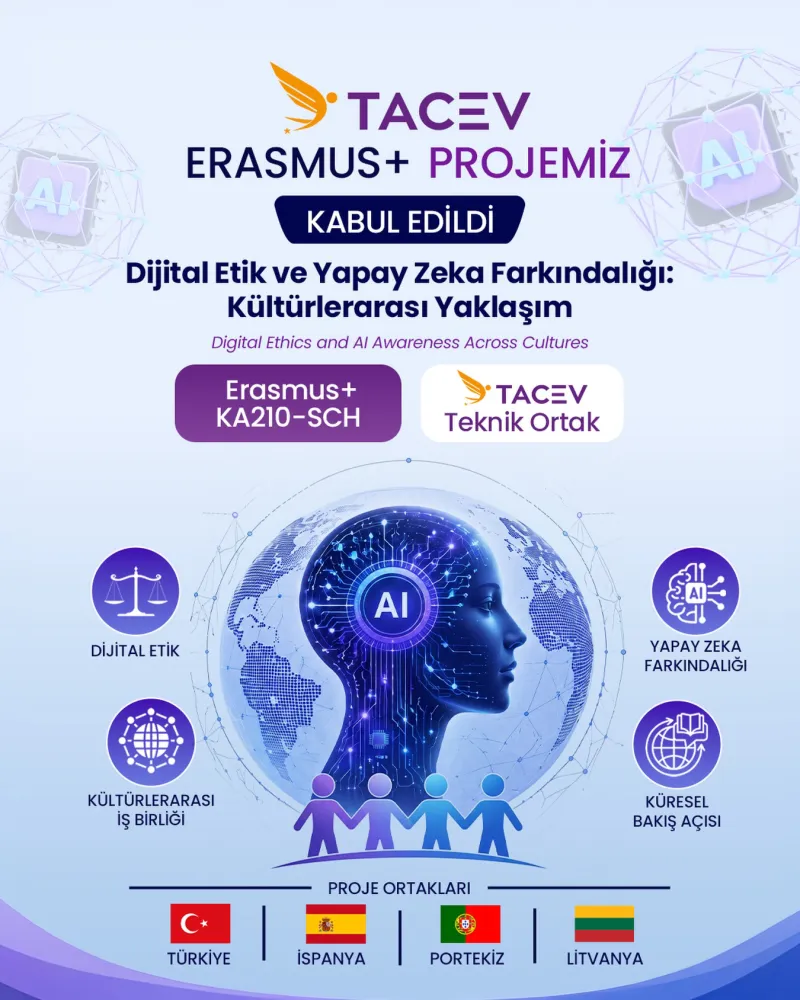
TACEV's project “Digital Ethics and Intercultural Artificial Intelligence Awareness”, prepared together with schools from four European countries, has been accepted under the European Union's Erasmus+ Programme.
The project was selected for funding among small-scale partnerships in the field of school education. It will begin on 4 October 2026 and run for 18 months, ending on 3 April 2028.
Alongside TACEV, the project partners are IES Miguel Hernández from Spain, AEPAS Ronfe from Portugal and Vytauto Didžiojo Licėjus from Lithuania. The aim is for young people aged 14–18 to get into the habit of asking “is this true, is it safe, is it fair?” when using artificial intelligence.
As part of the project, 12 ethical dilemma scenarios, four simulation games and a comprehensive teacher's guide are being developed jointly by teachers from the four countries.
All of the content will be brought together on a five-language online platform developed by TACEV, the project coordinator. By the end of the project, the aim is to increase the digital ethics awareness of 200 students by 30 per cent and the ability of 52 teachers to bring artificial intelligence into their lessons by 40 per cent.
At least 80 videos, e-posters and animations produced by students will be published in the platform's gallery, and a permanent “Digital Ethics Corner” will be set up at each partner school.